new

Get trending papers in your email inbox!

Subscribe

Trending Papers

byAK and the research community

Trending Papers

AutoDev: Automated AI-Driven Development

AutoDev is an AI-driven software development framework that automates complex engineering tasks within a secure Docker environment, achieving high performance in code and test generation.

  • 5 authors
· Mar 13, 2024
Submitted by
taesiri

Infinite Worlds with Versatile Interactions

An advanced world modeling system with extended interaction capabilities, real-time processing, diverse interactive elements, and multi-agent behavior control for collaborative virtual environments.

robbyant Robbyant · Jul 8, 2026

TradingAgents: Multi-Agents LLM Financial Trading Framework

A multi-agent framework using large language models for stock trading simulates real-world trading firms, improving performance metrics like cumulative returns and Sharpe ratio.

  • 4 authors
· Dec 28, 2024
Submitted by
taesiri

Scaling Mixture-of-Experts Video Pretraining for Embodied Intelligence

LingBot-Video presents a DiT-based video pretraining framework with Mixture-of-Experts architecture, specialized data augmentation, and multi-dimensional reward system for embodied intelligence applications.

robbyant Robbyant · Jul 8, 2026
Submitted by
taesiri

SkillOpt: Executive Strategy for Self-Evolving Agent Skills

SkillOpt introduces a systematic text-space optimizer for agent skills that trains skills as external agent state with stable updates and zero deployment inference overhead, achieving superior performance across multiple benchmarks and execution environments.

MicrosoftResearch Microsoft Research · May 22, 2026
Submitted by
fistyyyy

ResearchStudio-Idea: An Evidence-Grounded Research-Ideation Skill Suite from ML Conference Outcomes

ResearchStudio-Idea provides a skill suite for effective research ideation that combines literature search, novelty checking, and pattern-guided generation to produce traceable research proposals.

microsoft Microsoft · Jul 5, 2026

Continuous Audio Language Models

Audio Language Models (ALM) have emerged as the dominant paradigm for speech and music generation by representing audio as sequences of discrete tokens. Yet, unlike text tokens, which are invertible, audio tokens are extracted from lossy codecs with a limited bitrate. As a consequence, increasing audio quality requires generating more tokens, which imposes a trade-off between fidelity and computational cost. We address this issue by studying Continuous Audio Language Models (CALM). These models instantiate a large Transformer backbone that produces a contextual embedding at every timestep. This sequential information then conditions an MLP that generates the next continuous frame of an audio VAE through consistency modeling. By avoiding lossy compression, CALM achieves higher quality at lower computational cost than their discrete counterpart. Experiments on speech and music demonstrate improved efficiency and fidelity over state-of-the-art discrete audio language models, facilitating lightweight, high-quality audio generation. Samples are available at https://continuous-audio-language-models.github.io

  • 5 authors
· Sep 8, 2025
Submitted by
taesiri

MinerU2.5: A Decoupled Vision-Language Model for Efficient High-Resolution Document Parsing

MinerU2.5, a 1.2B-parameter document parsing vision-language model, achieves state-of-the-art recognition accuracy with computational efficiency through a coarse-to-fine parsing strategy.

  • 61 authors
· Sep 26, 2025
Submitted by
akhaliq

OpenDevin: An Open Platform for AI Software Developers as Generalist Agents

OpenDevin is a platform for developing AI agents that interact with the world by writing code, using command lines, and browsing the web, with support for multiple agents and evaluation benchmarks.

  • 24 authors
· Jul 23, 2024
Submitted by
ChengCui

PaddleOCR-VL-1.6: Expanding the Frontier of Document Parsing with Under-Optimized Region Refinement and Progressive Post-Training

PaddleOCR-VL-1.6 enhances document parsing performance through targeted data optimization and progressive post-training techniques, achieving state-of-the-art results on OmniDocBench v1.6.

PaddlePaddle PaddlePaddle · Jun 2, 2026
Submitted by
cherubicxn

Vision Pretraining for Dense Spatial Perception

Boundary modeling enables dense spatial perception by learning sub-pixel representations that enhance depth estimation and support embodied AI applications.

robbyant Robbyant · Jul 6, 2026

EverMemOS: A Self-Organizing Memory Operating System for Structured Long-Horizon Reasoning

EverMemOS presents a self-organizing memory system for large language models that processes dialogue streams into structured memory cells and scenes to enhance long-term interaction capabilities.

  • 11 authors
· Jan 5, 2026
Submitted by
xandergos

Terrain Diffusion: A Diffusion-Based Successor to Perlin Noise in Infinite, Real-Time Terrain Generation

Terrain Diffusion uses diffusion models and a novel algorithm called InfiniteDiffusion to generate realistic, seamless, and boundless procedural worlds with constant-time random access.

  • 1 authors
· Dec 9, 2025
Submitted by
taesiri

Unlimited OCR Works

Unlimited OCR introduces Reference Sliding Window Attention to eliminate growing memory consumption during long-sequence OCR tasks, enabling efficient transcription of multiple pages in a single forward pass.

baidu BAIDU · Jun 22, 2026
Submitted by
nielsr

Geometric Context Transformer for Streaming 3D Reconstruction

LingBot-Map is a feed-forward 3D foundation model that reconstructs scenes from video streams using a geometric context transformer architecture with specialized attention mechanisms for coordinate grounding, dense geometric cues, and long-range drift correction, achieving stable real-time performance at 20 FPS.

robbyant Robbyant · Apr 15, 2026
Submitted by
zli12321

Long-Horizon-Terminal-Bench: Testing the Limits of Agents on Long-Horizon Terminal Tasks with Dense Reward-Based Grading

AI agents have become capable of autonomously completing short, well-specified tasks. However, existing terminal benchmarks largely focus on simple problems that finish within minutes and are evaluated only by their final outcome. This setup overlooks intermediate progress and partial solutions, yielding sparse reward signals and an incomplete picture of agent capability. We introduce Long-Horizon-Terminal-Bench, a terminal benchmark of 46 long-horizon tasks spanning nine categories, including experiment reproduction, software engineering, multimodal analysis, interactive games, and scientific computing. Each task follows a Terminal-Bench-style setup with a reference solution or simulation engine, but is further decomposed into fine-grained graded subtasks. This design enables dense intermediate rewards and partial credit, allowing evaluation to capture not only whether an agent reaches the final goal, but also how far it progresses on open-ended workflows. Tasks in Long-Horizon-Terminal-Bench typically require hundreds of episodes and minutes to hours of execution, stressing long-horizon planning, long-context management, and iterative debugging rather than one-shot problem solving. We evaluate 15 frontier models and find that agents consume on average 9.9M tokens per task, with roughly 231 episodes and 85.3 minutes of execution time per run, making Long-Horizon-Terminal-Bench more demanding than prior terminal-based benchmarks. Even the strongest tested model achieves 15.2% pass@1 at a partial-reward threshold of 0.95 and 10.9% at a perfect-reward threshold of 1.0, while the mean pass rate across models is 4.3% and 1.7% under the two thresholds, respectively. These results reveal headroom for improvement. We further analyze failure modes and error patterns, and release Long-Horizon-Terminal-Bench to support future progress on long-horizon terminal agents.

Tencent-Hunyuan Tencent Hunyuan · Jul 9, 2026
Submitted by
akhaliq

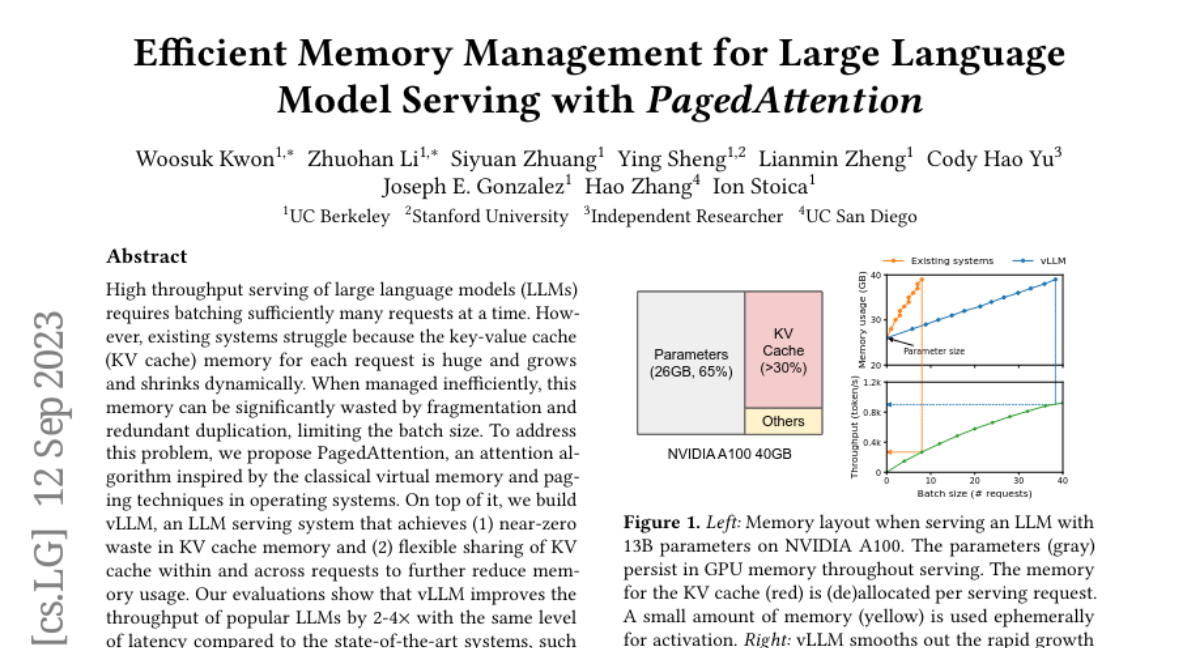
Efficient Memory Management for Large Language Model Serving with PagedAttention

PagedAttention algorithm and vLLM system enhance the throughput of large language models by efficiently managing memory and reducing waste in the key-value cache.

  • 9 authors
· Sep 12, 2023
Submitted by
andito

SmolDocling: An ultra-compact vision-language model for end-to-end multi-modal document conversion

SmolDocling is a compact vision-language model that performs end-to-end document conversion with robust performance across various document types using 256M parameters and a new markup format.

ibm-granite IBM Granite · Mar 14, 2025
Submitted by
shixuanke

Vision as Unified Multimodal Generation

A unified multimodal model formulates computer vision tasks as generation problems using natural language and visual prompts, achieving performance comparable to specialized systems across diverse vision tasks.

sensenova SenseNova · Jul 7, 2026
Submitted by
jt-zhang

Vidu S1: A Real-Time Interactive Video Generation Model

Vidu S1 is a real-time interactive video generation model that supports voice-controlled digital character animation with infinite-length output and high frame rate on consumer hardware.

Tsinghua Tsinghua University · Jul 3, 2026
Submitted by
zbhpku

DataFlow: An LLM-Driven Framework for Unified Data Preparation and Workflow Automation in the Era of Data-Centric AI

DataFlow is an LLM-driven data preparation framework that enhances data quality and reproducibility for various tasks, improving LLM performance with automatically generated pipelines.

PekingUniversity Peking University · Dec 18, 2025
Submitted by
Weiww99

From Foundation to Application: Improving VLA Models in Practice

LingBot-VLA 2.0 enhances generalization across tasks and embodiments through expanded data preprocessing and training on diverse robot configurations, extends action space to include whole-body degrees of freedom for complex manipulation tasks, and incorporates predictive dynamics modeling using video representation and depth estimation for improved temporal reasoning.

robbyant Robbyant · Jul 7, 2026
Submitted by
akhaliq

Mem0: Building Production-Ready AI Agents with Scalable Long-Term Memory

Mem0, a memory-centric architecture with graph-based memory, enhances long-term conversational coherence in LLMs by efficiently extracting, consolidating, and retrieving information, outperforming existing memory systems in terms of accuracy and computational efficiency.

  • 5 authors
· Apr 28, 2025

LMCache: An Efficient KV Cache Layer for Enterprise-Scale LLM Inference

LMCACHE enables efficient KV cache management for large language models by storing caches outside GPU memory, supporting cache reuse across queries and inference engines while achieving significant throughput improvements.

  • 11 authors
· Oct 8, 2025

OmniFlatten: An End-to-end GPT Model for Seamless Voice Conversation

A novel GPT-based model, OmniFlatten, enables real-time natural full-duplex spoken dialogue through a multi-stage post-training technique that integrates speech and text without altering the original model's architecture.

  • 9 authors
· Oct 23, 2024
Submitted by
nielsr

Ultralytics YOLO26: Unified Real-Time End-to-End Vision Models

YOLO26 addresses real-time vision challenges through a unified model family with NMS-free inference, improved training strategies, and multi-task capabilities spanning detection, segmentation, and pose estimation.

Ultralytics Ultralytics · Jun 2, 2026
Submitted by
akhaliq

Very Large-Scale Multi-Agent Simulation in AgentScope

Enhancements to the AgentScope platform improve scalability, efficiency, and ease of use for large-scale multi-agent simulations through distributed mechanisms, flexible environments, and user-friendly tools.

  • 8 authors
· Jul 25, 2024

Zep: A Temporal Knowledge Graph Architecture for Agent Memory

Zep, a memory layer service, outperforms MemGPT in the DMR benchmark and LongMemEval by excelling in dynamic knowledge integration and temporal reasoning, critical for enterprise use cases.

  • 5 authors
· Jan 20, 2025
Submitted by
taesiri

AgentScope 1.0: A Developer-Centric Framework for Building Agentic Applications

AgentScope enhances agentic applications by providing flexible tool-based interactions, unified interfaces, and advanced infrastructure based on the ReAct paradigm, supporting efficient and safe development and deployment.

  • 23 authors
· Aug 22, 2025

LightRAG: Simple and Fast Retrieval-Augmented Generation

LightRAG improves Retrieval-Augmented Generation by integrating graph structures for enhanced contextual awareness and efficient information retrieval, achieving better accuracy and response times.

  • 5 authors
· Oct 8, 2024
Submitted by
rubenohana

The Well: a Large-Scale Collection of Diverse Physics Simulations for Machine Learning

A large-scale dataset collection, The Well, provides diverse numerical simulations for benchmarking machine learning models in physical systems simulation.

  • 26 authors
· Nov 30, 2024
Submitted by
akhaliq

LlamaFactory: Unified Efficient Fine-Tuning of 100+ Language Models

LlamaFactory is a unified framework enabling efficient fine-tuning of large language models across various tasks using a web-based user interface.

  • 5 authors
· Mar 20, 2024
Submitted by
shanyou92

Kairos: A Native World Model Stack for Physical AI

Kairos is a world model framework that learns from diverse experiences, maintains persistent states through hybrid temporal attention mechanisms, and operates efficiently across different hardware platforms for physical AI applications.

  • 24 authors
· Jun 16, 2026

A decoder-only foundation model for time-series forecasting

A large language model adapted for time-series forecasting achieves near-optimal zero-shot performance on diverse datasets across different time scales and granularities.

  • 4 authors
· Oct 14, 2023
Submitted by
parachas

Signals: Trajectory Sampling and Triage for Agentic Interactions

A signal-based framework for efficiently triaging agentic interaction trajectories by computing low-cost indicators that identify informative samples without impacting online agent behavior.

digitalocean DigitalOcean · Apr 1, 2026
Submitted by
KumaPower

OPSD-V: On-Policy Self-Distillation for Post-Training Few-Step Autoregressive Video Generators

OPSD-V enhances few-step autoregressive video diffusion models by using real long-video data for temporal context during training, providing dense trajectory-level supervision that improves visual quality and motion dynamics without altering inference mechanisms.

MeiGen-AI MeiGen-AI · Jul 9, 2026
Submitted by
huohua325

MemSlides: A Hierarchical Memory Driven Agent Framework for Personalized Slide Generation with Multi-turn Local Revision

MemSlides presents a hierarchical memory framework for personalized presentation agents that separates long-term user profiles, working memory for session constraints, and tool memory for reusable execution experiences to enable stable personalization and reliable local edits across multi-turn revisions.

  • 4 authors
· Jun 15, 2026

Kronos: A Foundation Model for the Language of Financial Markets

Kronos, a specialized pre-training framework for financial K-line data, outperforms existing models in forecasting and synthetic data generation through a unique tokenizer and autoregressive pre-training on a large dataset.

  • 7 authors
· Aug 2, 2025
Submitted by
taesiri

GLM-5: from Vibe Coding to Agentic Engineering

GLM-5 advances foundation models with DSA for cost reduction, asynchronous reinforcement learning for improved alignment, and enhanced coding capabilities for real-world software engineering.

  • 186 authors
· Feb 17, 2026
Submitted by
RuofengYang

ARIS: Autonomous Research via Adversarial Multi-Agent Collaboration

ARIS is an open-source research harness that uses cross-model adversarial collaboration to ensure reliable long-term research outcomes through coordinated execution, orchestration, and assurance layers.

Submitted by
taesiri

Multiplayer Interactive World Models with Representation Autoencoders

A large-scale multiplayer world model trained on extensive gameplay data demonstrates stable long-horizon rollouts in a complex physics-based environment while maintaining coherence across multiple agents' actions.

  • 27 authors
· Jul 6, 2026
Submitted by
parachas

Arch-Router: Aligning LLM Routing with Human Preferences

A preference-aligned routing framework using a compact 1.5B model effectively matches queries to user-defined domains and action types, outperforming proprietary models in subjective evaluation criteria.

katanemo Katanemo · Jun 19, 2025

Multi-module GRPO: Composing Policy Gradients and Prompt Optimization for Language Model Programs

mmGRPO, a multi-module extension of GRPO, enhances accuracy in modular AI systems by optimizing LM calls and prompts across various tasks.

  • 13 authors
· Aug 6, 2025
Submitted by
taesiri

AlayaWorld: Long-Horizon and Playable Video World Generation

AlayaWorld is an open-source framework for creating interactive generative worlds that enables real-time user interaction and supports diverse actions within a modular architecture.

  • 17 authors
· Jul 7, 2026

PyTorch Distributed: Experiences on Accelerating Data Parallel Training

The PyTorch distributed data parallel module optimizes large-scale model training using techniques like gradient bucketing, computation-communication overlap, and selective synchronization to achieve near-linear scalability.

  • 11 authors
· Jun 28, 2020
Submitted by
Jeff-Wang

GigaWorld-1: A Roadmap to Build World Models for Robot Policy Evaluation

World models for robotic policy evaluation are systematically studied through a new benchmark, revealing that long-horizon rollout consistency and robot-specific controllability are more important than short-term visual realism for reliable policy assessment.

open-gigaai GigaAI · Jul 2, 2026
Submitted by
xcjthu

MiniCPM4: Ultra-Efficient LLMs on End Devices

MiniCPM4, a highly efficient large language model for end-side devices, achieves superior performance using innovations in sparse attention, pre-training datasets, training algorithms, and inference systems.

openbmb OpenBMB · Jun 9, 2025
Submitted by
Zonghao2025

Securing the AI Agent: A Unified Framework for Multi-Layer Agent Red Teaming

AI-Infra-Guard is an open-source framework that addresses AI infrastructure security through layered detection paradigms spanning infrastructure, protocol, agent behavior, and model layers.
tencent Tencent · Jun 30, 2026

IndexTTS: An Industrial-Level Controllable and Efficient Zero-Shot Text-To-Speech System

IndexTTS, an enhanced text-to-speech system combining XTTS and Tortoise models, offers improved naturalness, enhanced voice cloning, and controllable usage through hybrid character-pinyin modeling and optimized vector quantization.

  • 5 authors
· Feb 8, 2025
Submitted by
TianxingChen

RoboDojo: A Unified Sim-and-Real Benchmark for Comprehensive Evaluation of Generalist Robot Manipulation Policies

RoboDojo presents a unified sim-and-real benchmark for evaluating generalist robot manipulation policies across diverse tasks and evaluation dimensions.

RoboDojo-Benchmark RoboDojo-Benchmark · Jul 7, 2026